Showing posts with label technology. Show all posts

Wednesday, October 31, 2007

Lamborghini Reventon


Lamborghini released the details on their latest million dollar supercar. The Lamborghini Reventon is really going to be built in only 20 examples. We "guess" that the part where everyone of them is already sold is also true.

The Lamborghini Reventon is powered by a 6496 cc engine, developing 650 HP at 8000 rpm and has a peak torque of 660 Nm at 6000 rpm.

Lamborghini Press Release:

Automobili Lamborghini presents the new Lamborghini Reventon at the Frankfurt Motorshow
2007

The most extreme

The essence of the marque: just 20 examples of a

design masterpiece

Clearly a Lamborghini, but nothing quite like it. A super car without equals: the Lamborghini Reventon is a road vehicle with an extreme specification and, at the same time, a limited edition masterpiece – a coherent style, angular with sharp lines, inspired by the very latest aeronautics.

With just 20 produced, each 1 Million Euro (without taxes) Lamborghini Reventon is a symbol of extreme exclusivity, yet still offering the extraordinary performance that makes the Lamborghini Reventon so unrivalled: under the completely autonomous design, the
Lamborghini Reventon possesses the entire technical and dynamic competence of the twelve cylinder Lamborghini.

Lamborghini prides itself on being the extraordinary manufacturer of extreme super sports cars without compromise. Sensuality and provocation characterise every Lamborghini, with an aggressively innovative style. “However, the Lamborghini Reventon is the most extreme of all, a true automotive superlative. Our designers at the Lamborghini Style Centre took the technical
base of the Murciélago LP640 and compressed and intensified its DNA, its genetic code,” affirms Stephan Winkelmann, President and CEO of Automobili Lamborghini S.p.A.

The Lamborghini Reventon has been entirely designed in Sant’Agata Bolognese, the original birthplace of the Lamborghini and the native home of every super car born under the sign of the bull. The design drawn up in Lamborghini’s Centro Stile (Style Centre) is fine-tuned in close collaboration with the Lamborghini Research and Development Department. Thus, the Lamborghini Reventon is not only “haute couture” but it also stands out for its elevated
dynamism whilst being entirely suitable for every day use.

The Lamborghini Reventon is not destined to remain a one-off. A total of 20 Lamborghini friends and collectors will be able to own this extraordinary car and, naturally, enjoy the
incomparable pleasure of driving it.

Born in Sant’Agata Bolognese


The name Lamborghini Reventon has been chosen according to Lamborghini tradition. Lamborghini Reventon was a fighting bull, owned by the Don Rodriguez family. It is included in the list of the most famous bulls ever and is known for killing the famed bullfighter Felix
Guzman in 1943.

Inspired by the fastest airplanes

The present day Lamborghini models are distinguished by the clear language of their shape. The coherent proportions of the Murciélago and Gallardo highlight their power and dynamism. Sharp edges, precise lines and clean surfaces: these are ingredients of a style reduced to the essential. Each element is created exactly according to its function; ornaments and decorations are totally foreign to a Lamborghini.

With the Lamborghini Reventon the Centro Stile designers have coherently developed this philosophy, inspired by another sphere where speed and dynamism reign absolute: modern aeronautics, responsible for the fastest and most agile airplanes in the world. This has created an extremely precise, technically striking style with a new vitality: interrupted lines and contorted surfaces create a fascinating play of light, giving the car incredible movement.
Made of carbon fibre and precision

Although it is based on the extraordinarily successful Murciélago LP640, the exterior design of the Lamborghini Reventon is completely new. Just like the base model, the exterior is made of CFC, a composite carbon fibre material, which is as stable as it is light. The exterior components are glued and fixed to the body comprised of CFC and steel.

The front is characterised by the acute angle of the central ‘arrow’ and by the powerful forward-facing air intakes. Although they do not supply air directly to the turbine like an airplane, bearing in mind the 650 hp, an abundant volume of air is necessary to cool the carbon brake disks and the six cylinder callipers.

Characterised by coherent functions

Naturally, both doors on the Lamborghini Reventon open upwards – since the legendary Countach this has also been a symbol of the V12 Lamborghini product line. With their asymmetric configuration, the large air intakes below the doors provide an example of the extreme coherence with which a Lamborghini fulfils its function: on the driver's side it is large to increase the flow of oil to the radiator. On the passenger’s side of the vehicle, the air intake is flat because in this case, it only has to ensure the flow below the floor. The aerodynamically optimised flat floor structure terminates at the rear with a diffuser featuring an accentuated shape. This guarantees excellent road grip and stability even at 340 km per hour.

In spite of the extreme and innovative language of its shape, the Lamborghini Reventon not only maintains all the strong features of the Murciélago LP640, but also offers further amelioration in terms of aerodynamics, the important engine cooling system, the air intake system and brakes. The airflow and the section of the variable geometry air intakes of the engine and the rear spoiler (also adjustable) have been modified. Owners of the 20 examples will be able to test the performance of his or her Lamborghini in person.

Perfected to the ultimate detail

The engine hood made of glass laminate with open ventilation slits offers a glimpse of the beating heart of the twelve cylinders of the super car. The glass also features the marked arrow angle that characterises the design from the front to the rear spoiler. The Lamborghini designers’ love for detail is beautifully illustrated by the fuel tank lid: a small mechanical work of art, achieved by milling a solid aluminium block.

The combination lights transform the incisiveness of the design into light: the front features the most modern light-emitting diodes alongside Bi-Xenon headlights. Seven LEDs ensure continuous daylight while there are a further nine diodes for the indicator and hazard lights. Another technical innovation is found in the rear light LEDs. Because of the high temperature in the rear low part of the car, special heatproof LEDs are used for the indicator and hazard lights, stoplights and rear lights with a triple arrow optical effect.

A new body colour

Naturally, such a refined language of shape also demands an extraordinary colour. For the 20 examples of the Lamborghini Reventon, the designers from Sant’Agata Bolognese have created a totally new hue: Lamborghini Reventon, a mid opaque green/grey without the usual shine. However, thanks to the metallic particles, in the daylight this colour tone features surprising depth.

Opaque and brilliant colours for the wheel rims

This play of opaque and lustre is also featured on the wheel rims, especially created for the Lamborghini Reventon. Opaque carbon fins are screwed onto the black aluminium spokes, not only creating a visual effect with the precision of a surgeon’s scalpel, but a turbine effect also ensures optimum cooling for the powerful ceramic brake disks.

TFT display similar to an airplane

The same innovative force applied to the exterior design characterises the cockpit of the Lamborghini Reventon. Designed and created using Alcantara, carbon, aluminium and leather that comply with the top quality standards, the interior is inspired by the next generation cockpits: just like in modern airplanes, the instruments comprise three TFT liquid crystal displays with innovative display modes. At the touch of a button, the driver can choose from two vehicle information display modes. The instruments are housed in a structure milled from a solid aluminium block, protected by a carbon fibre casing.

The G-Force-Meter is also completely new: this display shows the dynamic drive forces, longitudinal acceleration during acceleration and braking, as well as transversal acceleration around bends. These forces are represented by the movement of an indicator on a graduated 3D grid depending on the direction and intensity of the acceleration. A similar instrument can be found in the airplanes. Formula One teams also use a similar device to analyse dynamic forces.

Customisable instruments

The instrument on the left of the speedometer associates the number of revolutions in the form of a luminous column with the display of the selected gear. Finally, every Lamborghini Reventon is equipped with a robotised e.gear controlled by two small levers under the steering wheel.

By simply pressing a button, the driver can switch to the second, quasi-analogical display, where the classic circular instruments, speedometer and engine speed indicator are configured in an equally innovative way and transformed into luminous pilot lamps with varying colours. The G-Force-Meter naturally remains at the centre in this display mode.

Electronic system developed entirely by Lamborghini

All this is possible thanks to the fact that the entire electronic platform of the Lamborghini Reventon, together with all the control devices, has been autonomously developed by the Lamborghini experts.

The same process for integrating the electronic displays in the car was applied to the Lamborghini Engineering Department.

From the conception of the very first radical ideas, the entire Lamborghini Reventon has been developed in Sant’Agata Bolognese thanks to tight teams of remarkably creative experts. An extremely refined and efficient process was employed: CAD design and development, creation of the prototype in the Prototype Department, all carried out under the constant supervision of the Research and Development Department’s technicians and testers.

Atelier of creativity and high efficiency

Inaugurated in 2004, the Centro Stile is dedicated to design and characterised by a high degree of efficiency: an “atelier” of creators, designers and prototype constructors, who encapsulate the Lamborghini culture and spirit by using their remarkable skills to create aesthetic innovation.

The Centro Stile is located in a 2,900 square two-storey building. The large pavilion houses two test floors and related production and analysis equipment, while other rooms are set aside for the most advanced computerised workstations for designers and a style-model construction workshop. The Centro Stile is also closely linked to the nearby Engineering Department: the direct line between the Lamborghini development departments guarantees that ideas rapidly become reality.

Creativity and production under the same roof

The Lamborghini Reventon is a practical illustration of the streamlined functionality and efficiency characterising the Centro Stile: it took less than a year to progress from the first ideas to the finished car. The complete design process from the first sketches on paper, to three dimensional computer models with 1:10 or 1:4 scale, right up to the real size prototype is organised around streamlined, fast, efficient work groups. Thanks to the Centro Stile, for the first time in its history, Lamborghini is now able to create its own style philosophy in-house without having to rely on any external collaboration.

The 20 units will be manufactured in Sant’Agata, using a production process characterised by artisan perfection and rigorous quality standards.

A masterpiece with tested technology

The technology found in the Murciélago LP640 has not been modified. The engine in the LP640 forwards is the classic twelve-cylinder engine with 6.5 litre displacement. Only for this car, Lamborghini guarantees, an astounding 650 HP (478 kW) at 8,000 revolutions per minute (rpm). The huge torque, equal to maximum 660 Nm, ensures a powerful switch from any number of revolutions: even the slightest pressure on the accelerator is spontaneously transformed into thrust. The robotised e.gear changes gear faster than even the most expert driver. In addition, the permanent Viscous Traction four-wheel drive system ensures that every force is constantly translated into movement.

As in the original Murciélago LP640, the Lamborghini Reventon accelerates from 0 to 100 km/h in just 3.4 seconds, with a maximum speed over 340 km/h.

Born to become a legend

Since its foundation, Lamborghini has been a creator of trends in the world of sports cars and has always manufactured cars with an absolutely unmistakable character. Models such as the Miura or Countach, for example, were veritable forerunners and rapidly acquired the status of timeless classic cars. From the moment they are launched, every new Lamborghini promises to become a legend, destined to become a sought-after and precious possession.

With the Lamborghini Reventon, Lamborghini has done it again; it has created an unequalled super car; the perfect synthesis between the exclusivity and appeal of a limited edition design masterpiece, and the dynamism and driveability of a standard sports car. Thus, the Lamborghini legend is further enhanced by another, stylish future classic.

Lamborghini Reventon Technical data

Frame
High strength tubular steel structure with carbon fibre components.

Bodywork
In carbon fibre, except roof and door external panels (steel)

Steering
Type Mechanical (rack and pinion) power-assisted
Right-hand turning circle 12.55 m (41.17 ft)


Wheels and tyres
Front 245/35 ZR 18
Rear 335/30 ZR 18


Engine
Type 12 cylinders at 60°
Bore and stroke 88 mm x 89 mm (3.46 in x 3.50 in)
Displacement 6496 cc (396.41 in3)
Compression ratio (11  0.2):1
Maximum power 650 HP (478 kW) at 8000 rpm (guaranteed through the engine selection)
Maximum torque 660 Nm (487 lb-ft) at 6000 rpm
Engine position in vehicle Longitudinal central-rear
Cylinder heads and engine block Aluminium
Intake system Variable geometry with 3 operating modes

Timing
4 valves per cylinder, 4 overhead camshafts
Timing gear transmission 2 chains
Continuous timing variator (int. and ex.) Electronically controlled

Ignition system
Static type ignition system with individual coils (one for each spark plug).
Firing sequence 1-7-4-10-2-8-6-12-3-9-5-11


Fuel system/injection
Lamborghini LIE electronic engine control unit, multipoint, sequential timed, DRIVE BY WIRE

Lubrication system
Type Dry sump
Recovery pumps 2 gear pumps
Delivery pump (high pressure) 1 gear pump


Cooling system
Type Liquid cooled, with pressurized circuit

Transmission
Type of transmission Permanent all-wheel drive with Viscous Traction system
Gearbox 6-speed mechanical gearbox
Clutch Dry single disc
Clutch disc diameter 272 mm (10.7 in)

Transmission ratios Gearbox:
Ist 1:3.091
IInd 1:2.105
IIIrd 1:1.565
IVth 1:1.241
Vth 1:1.065
VIth 1:0.939
Reverse 1:2.692

Brakes
4 self-ventilated rotors with pedal control, hydraulic transmission with dual independent circuits, one for each axle with vacuum servo.
ABS antilock device + DRP function.

Steel brake lines
Front rotor Ø 380 x 34 mm (14.96 in x 1.34 in)
Front calliper cylinders N. 8 (32-28 mm/32-28 mm)
(1.26 in-1.10 in/1.26 in-1.10 in)
Rear rotor Ø 355 x 32 mm (13.98 in x 1.26 in)
Rear calliper cylinders N. 4 (40-44 mm)
(1.57 in-1.73 in)
Ceramic rotors system (Optional)
Front rotor Ø 380 x 38 mm (Ø 14.96 in x 1.5 in)
Front calliper cylinders N. 6 (32-36-38 mm) (1.26 in-1.42 in-1.5in)
Rear rotor Ø 380 x 38 mm (Ø 14.96 in x 1.5 in)
Rear calliper cylinders N. 6 (32-36-38 mm) (1.26 in-1.42 in-1.5in)
Handbrake Mechanical, acting on rear wheels

Suspension
4-wheel independent articulated quadrilateral system. Hydraulic shock absorbers and coaxial coil springs. Suspension with dual front and rear struts, antiroll, antidive and antisquat bar.

Performance data
Top speed 340 km/h (211.3 mph)
Acceleration 0-100 km/h (0-62 mph) 3.4 s (before: 3.8 s)

Dimensions
Wheelbase 2665 mm (104.92 in)
Total length 4700 mm (185.04 in)
Total width 2058 mm (81.02 in)
Total height 1135 mm (44.69 in)
Dry weight (no fuel and no liquids) 1665 kg (3670.7 lb)
Front trackwidth 1635 mm (64.37 in)
Rear trackwidth 1695 mm (66.73 in)
Front overhang 1080 mm (42.52 in)
Rear overhang 955 mm (37.60 in)
Maximum overall width with external rear-view mirrors 2215 mm (87.20 in)

Liquid capacities (litres)
Engine oil 12 litres (3.17 gal)
Gearbox oil 3.5 litres (0.92 gal)
Front differential oil 1 litre (0.26 gal)
Rear differential oil 2.5 litres (0.66 gal)
Cooling circuit 15 litres (3.96 gal)

Consumption (according to DIR 1999/100/CE)
Urban 32,3 l/100km
Extra-urban 15,0 l/100 km
Combined 21,3 l/100 km
CO2 emissions 495 g/km

Friday, October 26, 2007

2009 Nissan Skyline GT-R

1. Package of Nissan GT-R

The Nissan GT-R package balances this power with practicability - two contradicting factors - to realize a new dimensional multiperformance supercar with ultimate performance for " anyone, anywhere, anytime" . Offering the acceleration performance of a supercar, the Nissan GT-R holds a higher dimension of 'cornering and braking'.


2.Premium Midship Package

The Nissan GT-R adopts a newly developed Premium Midship package, a furtherly advanced form of the FM (Front Midship) package. " Force of the Earth" - Utilizing natural forces to the maximum - Returning to the fundamental principle of what an automobile should be, the vehicle is designed to convert inertia force, generated by the earth's natural forces (gravity) and the vehicle in movement, into tire grip, and change airflow into a stabilizing force. As a result, Nissan developed a drive system especially and exclusively for the new Nissan GT-R called Independent Transaxle 4WD (Nissan patent). This independent transaxle 4WD was unified with the rear final drive unit, and the front and rear were integrated by a carbon propeller shaft, after moving the clutch, transmission, and transfer to the rear of the vehicle for the first time in world.

2-1. Stabilized ground load on all four wheels

On conventional vehicles, there was a tendency for front wheels to loose adhesion from meeting resistance of an invisible wall of air, causing load to slip. The load shifts to the rear as drive force is applied, causing the front wheels to lift, lighter steering. Especially in rainy weather when air density rises, the front wheels lift further, creating a higher possibility for a hydroplane phenomenon to occur. In order to stabilize load-distribution on all four wheels, the basic elements for packaging were reconsidered, to create a package that fully utilizes natural forces of the earth.


Optimized Load Distribution

Discussion on load distribution of conventional vehicles has been focused on the static load distribution during stopping. However, to ultimately heighten the fundamental performances of "driving, cornering, braking" , inertia load shift has been fully separated and independent between the front and rear wheels; the engine load on the front tires and transaxle load on the rear. In addition to this, the transaxle placed below the rear wheel center lowers the center of gravity of the vehicle. The Nissan GT-R, capable of utilizing inertia load, realizes ultimate flat riding comfort with minimal load shift during braking, cornering and any driving situation.


Optimized Dimension

The basic dimension of the vehicle has also been optimized. Run-flat tires with a large diameter and high capacity have been adopted to maximize the tire grip area where power and torque are applied, and optimize power weight and torque weight ratio... Heavy load is placed in the center of the vehicle based on the wheelbase tread. A brake with powerful braking force, is adopted to handle " driving and cornering" . The optimized dimension realizes balanced load distribution on all four wheels, improved cornering performance and stability, pitching convergence, damping force and braking force improvement, and minimized shift in posture.


Fun-to-Drive Range Expanded


As load distribution is evenly balanced on all four wheels with the optimized load distribution and dimension, vehicle behavior is easy to grasp, allowing the driver to start accelerating earlier. In addition, powerful traction of the front wheels helps the vehicle to accurately accelerate in the steered direction. With this newly created " traction steering" driving concept, the fun-to-drive range is widely expanded.

2-2. Balanced combination of powertrain cooling performance and aerodynamics
The newly developed Premium Midship Package has achieved a balance in the improvement of aerodynamics and cooling, two contradictory performances of the powertrain. The Nissan GT-R designers moved the transmission from just behind the engine to the rear. Cooling air passes over the engine, enters a space where the transaxle would normally be, then passes through the floor tunnel to cool the transaxle. This cools the powertrain far more efficiently. Creating this flow from the engine room to through the floor tunnel enables downforce air control under the floor, just as a racing car.


Aerodynamics and Cooling Performance

Working 2 years with Group Lotus in Europe to develop more efficiently, and 1.5 years with Yoshitaka Suzuka in Japan for aerodynamic development using moving belt systems, the vehicle has successfully balanced low air-resistance (2 sets o 2 sets o:0.27) and greater downforce - something formerly believed to be impossible - to realize aerodynamic performance on a par with racing realized . Higher front and rear downforce gives the Nissan GT-R better grip, improves active safety performance, reduces air resistance (Cd: 0.27) and raises fuel-8.


Reduced wind noise

The wind noise during high-speed driving has been reduced by careful reconsideration of the form of each body part. The under floor noise is controlled with the minimized floor through-hole and rectification due to vehicle undercover. This allows the driver to drive at 300km/h on the Autobahn and still enjoy conversation with the person in the passenger seat.


2-3. Reduced powertrain vibration

In the Premium Midship package which adopts an independent transaxle 4WD, powertrain vibration is highly reduced and durability potential at maximum speeds is highly improved. The engine and transmission are independently antivibration mounted, and the transmission placed further away from driver helps clear the engine sound and greatly reduces air noise around the driver seat. This quiet cabin in high-speed driving is made possible by preventing mechanic vibration noise that was formerly generated from the unified engine and transmission at around 4000 revs. The overall length of each the engine and the transaxle, which are separated/ joined by the high vibration damping carbon fiber propshaft, are shorter compared to the conventional FR-4WD vehicle. This highly improves powertrain durability performance at maximum speeds and increases the potential of high-speed driving.

Enhanced noise and vibration performance potential


Enhanced high-speed durability performance potential


3. Driving position and utility

In the Premium Midship package, the transmission has been moved from just behind the engine to the rear, expanding the foot space in the cabin and creating enough space to design an optimized pedal layout. Also, the adoption of run-flat tires helps to realize a larger and flatter trunk space.

Driving Position


Ideal driving position space for supercar drivers-Horizontal distance from floor surface to hip point: 200mm

-Tilt mechanism from the base is applied to keep the steering wheel angle optimized
-The steering position adjusts to optimized angle. (Tilt: 60mm; telescopic: 60mm
-The largest seat position coverage in supercar market Long seat slide: 228mm, lift amount: 30mm
-The best driving position from short females to tall males / 144cm-190cm Optimized pedal layout for smooth operation
-Pedal stroke extension: 65mm (Fairlady Z (Z33): 55mm)
-Optimized pedal angle: 42.5 degrees (Fairlady Z (Z33):37।5 degrees)
-Acceleration pedal surface slip amount: 4.3mm


Cockpit

To enable the driver to fully concentrate on safe driving especially at high speeds, the door mirror, combination meter and multifunction meter are positioned an uniformed height, minimizing the driver's eye movement while driving.

Trunk room

Thanks to the flat floor by abolishing the spare tire, larger trunk room than the other super cars is realized 2sets of golf bags ( 8.5 inches) or a pair of Special A size suitcase and C size suitcase can be loaded. (Trunk room height:435mm, length:850mm, width (maximum):1470mm)


Tuesday, September 25, 2007

The New Golf GTI Pirelli - Key Aspects


Source - Volkswagen


  • World premiere at Wörthersee: Comeback of the GTI Pirelli
  • Traction control: New Pirelli 18-inch wheels and size 225 P-Zero tires
  • Unique character: Seat and seatback surfaces of sports seats with tire tread design
  • Sports car engine: Golf GTI Pirelli has 230-PS engine from GTI Edition ३०

  • The Golf GTI Pirelli is back; a powerful, fast and very exclusive GTI. Volkswagen is continuing the history of one of the best known limited edition models in Europe. In May 1983, the 'Original Pirelli' arrived on the market. It was based on the first generation, second series Golf GTI. A distinctive identifying feature: Specially designed alloy wheels with the 'Pirelli P' on their outer edges. A remarkable 10,500 cars of the special model were built and sold within half a year. Then it was over – a limited edition! If there were an Automobile Hall of Fame for young-timers, the 'Pirelli GTI', as it was called by its fans, would have long held a place there।The legendary tire tracks of the young-timer are now being extended by the new Golf GTI Pirelli. And indeed with completely new Pirelli high-performance tires too. They are wrapped around powerful 18-inch Pirelli wheels in Titanium look. The car's interior has been upgraded with a partial-leather sports seat system that has an embedded tire tread pattern. Instead of the previous 112 PS the new car converts 230 PS into forward propulsion. If needed, a 245 km/h top speed is within the car's capabilities. In 6.8 seconds the Turbo-FSI propels the GTI Pirelli to 100 km/h from a standstill.The Golf GTI Pirelli, conceptualized by Volkswagen Individual, will be presented in a worldwide debut between May 16 and 20. The occasion and site of this premiere are a perfect fit: The international GTI Meeting at Wörthersee, Austria. Production will begin in September.


    Driving performance of the Golf GTI Pirelli।

    A look at the numbers gives it away: 169 kW / 230 PS – those are the same performance values as the engine in the Golf GTI Edition 30 that arrived on the market in 2006 on the occasion of the GTI's monumental birthday. The 200 PS of the 'normal' GTI were boosted by one PS for each year since 1976. Now this 'jubilee engine' is also powering the Golf GTI Pirelli. The sports car races to the 100 km/h mark in just 6.8 seconds. But it can go even faster: When the GTI Pirelli is ordered with the optional DSG dual clutch transmission, the most powerful GTI of all times breaks through the magic 'sound barrier' in 6.6 seconds. The GTI philosophy of agility is accompanied by the efficiency with which this Turbo-FSI goes to work: 8.2 liters of fuel per 100 kilometers, or 7.9 liters with DSG, are evidence of the virtuosity with which Volks­wagen masters the keyboard of engine building.


    Tires and wheels of the Golf GTI Pirelli

    'Power is nothing without control', says Pirelli. Volkswagen sees it this way too. Chassis, brakes and ESP combine for a well-balanced safety package that can even perform masterfully on the North Loop of the Nuremburg Ring track. But things do not really get rounded out until the tires come into play. That is why Pirelli is contributing a new high-performance tire to the project: The latest generation of P-Zero tires. The material mixture and tread pattern of the 225/40 P-Zero were designed to benefit handling, braking, ride comfort and aquaplaning properties.As in 1983, the tires are wrapped around Pirelli alloy wheels. They are coated with a Titanium-colored paint. The manufacturer interprets the visual effect of the five spokes as an homage to the wheels of the first Pirelli GTI. They had openings in the form of a P for Pirelli on their outer edges. This P is also found in the new wheel design – but in this case it is reflected: In the rim flange. However, there are worlds of difference between the dimensions of the two types of alloy wheels: They are 7.5x18 inch today, but were 6x14 inch back then.


    Body of the Golf GTI Pirelli

    Bumpers and side skirts painted entirely in car color visually set the Golf GTI Pirelli apart from the 200-PS GTI. Recall that on this classic GTI, introduced at the end of 2004, the spoiler in front, the lower bumper section in the rear, and the skirt between the wheel housings on the sides were in black.Similar to the GTI Edition 30, a plate with the Pirelli signature on the right side of the tailgate is a reference to this exclusive Golf GTI. In its side profile, the new car has standard tinted rear windows and another Pirelli signature can be seen here on the C-pillar of each side. Designers coordinated the color of the signature to the body paint color. Four of these are offered on the Golf GTI Pirelli. If 'Blue graphite' or 'Black magic pearl' is selected, the Pirelli signature is in silver. If the GTI – available as a two-door or four-door – is ordered in 'Sunflower' or 'Reflex silver', there is a black signature. 'Sunflower' – a bright yellow – was created especially for this GTI. So if you look in your rearview mirror this coming fall and see something yellow with a black radiator grille growing larger very quickly, it can only be one thing: The Golf GTI Pirelli.


    Interior of the Golf GTI Pirelli

    Just as distinctively as on the GTI Edition 30, the GTI Pirelli stands out from the rest of the model series with its refined interior. Take the example of the sports seating system: The standard GTI seats developed by Volkswagen Individual were upgraded to perfectly customize them for the GTI Pirelli: The anthracite colored lateral supports, seatbacks, head restraints and center armrests are upholstered in leather ('Vienna' type); yellow decorative seams provide a fine visual contrast. But the real highlight is the center seat panels. They are not made of the usual GTI 'Interlagos' diamond pattern, rather of a breathable and very luxurious microfiber from the Italian producer Miko ('Dinamica' type): The tire tread pattern is embedded in the microfibers, which also sport the anthracite color. There is yet another accent in the front head restraints. Where the 'GTI' letters are usually found, in this car the lettering is 'Pirelli' throughout.'Pirelli' equipment features also include heated seats, electrically adjustable lumbar supports in front, and all-leather center armrest in the rear. Under its counterpart in front, there is a storage bin that may be used optionally to house a CD-changer or MP3 player.The leather sports steering wheel and parking brake grip have been retooled to match the top sports seats: They also have decorative yellow seams. In addition, the steering wheel with ergonomic hand recesses and perforated leather here support a sporty driving style. The vertical spoke of the steering wheel has a metallic Pirelli emblem as an accent.


    Engine of the Golf GTI Pirelli

    It was 25 years ago when Volkswagen first introduced the era of downsizing on its first turbo-diesel. Of course, the Turbo-FSI on the GTI is technically unrelated to a turbo-diesel, but they have the principle of downsizing in common – in both cases engine displacement is replaced by engine charging. Approximately one decade after the first turbo-diesel, the direct-injection TDI followed. This engine extended the principle of downsizing to include the aspect of direct injection. This mix of technologies yielded lower fuel consumption and emissions, and more torque and power. On the Golf GTI, Volkswagen has transferred its 2004 downsizing concept to a powerful gasoline engine for the first time; its use of a turbocharger with intercooler plus direct injection brings fuel economy and sportiness in greater harmony than ever. The proof of this is measurable: The 147 kW / 200 PS and 280 Newton-meter strong Turbo-FSI of the 'normal' GTI attains a top speed of 235 km/h and takes 7.2 seconds for the sprint to 100 km/h. Average fuel consumption: Exceptionally low for a sports car at 8.0 liters per 100 kilometers. If the GTI is shifted by DSG, fuel consumption is reduced to 7.9 liters.The Golf GTI Pirelli is proof today of the potential in combining gasoline direct injection and charging. Its turbocharged direct-injection gasoline engine is currently the most powerful four cylinder engine from Volkswagen. This front-mounted transverse engine is shifted by a standard manual six-speed gearbox. The 16-valve four cylinder with 1,984 cm3 displacement outputs its maximum power of 169 kW / 230 PS at 5,500 rpm. Its maximum torque of 300 Newton-meters is available over a large speed window – from 2,200 to 5,200 rpm. Nothing is more befitting a sports car than this sort of torque characteristic.And the efficiency of the charged VW direct injection gasoline engine is measurable here too. In spite of an extra 30 PS, 20 Newton-meters and 10 km/h top speed, compared to the 200-PS version the manually shifted Golf GTI Pirelli consumes just 0.2 liters more fuel per 100 kilometers. When shifted by a DSG dual clutch transmission, its fuel consumption is even identical at 7.9 liters per 100 kilometers!

    2008 Project Kahn Mercedes-Benz SLR


    Project Kahn Press Release

    Project Kahn Mercedes-Benz SLR 2008Project Kahn was created to challenge conventions and redefine ideals, our studio tailors luxury bespoke vehicles for individuals that can not submit to a life of monotonous uniformity and will only accept perfection. It is our duty at Project Kahn to predict and outmanoeuvre the market in which we operate, releasing new products to satisfy even the most demanding of customers, with this in mind we unveil the Project Kahn Mercedes-Benz SLR.

    The Mercedes-Benz SLR is as standard an extraordinary vehicle, however here at Project Kahn we always believe there is room for improvement. Our SLR includes a sports exhaust system, lowered sports suspension, the soon to be released Kahn SLR body styling package, Kahn RS-X alloy wheels and a 60 bhp engine upgrade all built on a very impressive standard SLR specification.

    Project Kahn Mercedes-Benz SLR 2008As with all Project Kahn vehicles we also give the option of custom paintwork and custom leather interior, giving the car even more individuality and with the 9" x 20" front and 10.5" x 21" rear RS-X alloy wheels perfection will truly be achieved. For full details on the Kahn SLR and other products by Project Kahn, visit the official Project Kahn website.

    Hyundai Genus


    World debut for Hyundai Genus concept at Geneva

    Centrepiece of Hyundai's presentation at the Geneva Motor Show next month will be the world debut of its new Genus concept vehicle, a premium crossover model that combines the sporting dynamism of a coupe with the versatility of an estate car.Genus is the work of Hyundai's European design centre in Rüsselsheim, Germany, its styling inspired by the natural forms created by waves and tides. The concept previews the kind of vehicle that will respond to the developing customer tastes and expectations Hyundai has identified in the upper medium D-segment.The Geneva show will also herald the first European appearance of the all-new, second-generation Hyundai Santa Fe, following its unveiling earlier this year in Detroit.
    Source - Hyundai


    HYUNDAI UNVEILS GENUS NEW GENERATION WAGON AT '06 GENEVA MOTOR SHOW

    Coupe-wagon crossover - Lifestyle approach to modern vehicle construction With the Genus concept vehicle which makes its international debut today at the 2006 Geneva Motor Show, Hyundai Motor Co. is taking a preview on future European customer demand in the D-segment. Created at the Hyundai European Design Center in Rüsselsheim near Frankfurt, Genus combines the sporting dynamism of a coupe with the versatility of a traditional wagon.'The dynamic five-door concept blends roominess and comfort with elegance and practicality. The Genus challenges the traditional compromise of vehicle choice faced by demanding modern lifestyles. It offers space and comfort, similar to a traditional wagon, but has an elegant, dynamic exterior. The Genus thus provides the answer to emotional desires and practical necessity, ' explains Thomas Bürkle, Chief Designer at Hyundai's European Design Center.CapabilityThe Rüsselsheim design team developed the Genus as a D-segment vehicle with a broad appeal to many target groups. Thus, with its multi-use concept the Genus can be used for work, extensive shopping tours, family holidays as well as for numerous free time activities.A long wheelbase, reduced front and rear overhangs and a wide stance enable increased interior comfort and loading capacity without compromising the fundamental proportions inherent to a coupe. For maximum versatility, the floor features an integral hatch which can be lifted to reveal a retractable bench seat. The bench extends out to rest over the trunk sill and together with a sliding deck that is concealed in the bumper, it forms a multi-use outside seating area. The sliding deck can also be used separately for transportation of bicycles and other sports equipment.Due to an inset B-pillar, the side windows form a continuous line. They are fully retractable and together with a large panoramic glass roof enable multi-sensorial experiences normally associated with coupes and cabriolets.The medium-size wagon is powered by a 2.2 liter Common-Rail Diesel engine (CRDi) and equipped with a 5-gear automatic transmission for a dynamic, yet comfortable and economic ride. The 4WD underlines the sporty character of the Genus.


    Exterior Design

    The formal language of the purist concept has been defined by the free-flowing form of a wave. Expressive Front and rear blend in a harmonious fusion through a constantly evolving extruded body, painted in metallic champagne.The face is defined by a hexagonal mouth taking up the whole front like the air intake of a fighter plane, where all surfaces start around it and develop into the body side. The jewel-like swept-back headlamps are similar to birds' eyes that sit on the flanked side of the truncated triangular shaped front end.Strongly looking A-pillars are firmly routed in the sculpted bonnet producing a flight of an arrow section, which shoots towards the front grill.The flowing silhouette of the car has a sleek cab forward configuration with a tapering roofline dropping dramatically away at the rear. Uninterrupted negative shoulders connect the slanted narrow greenhouse onto the tall body, giving it almost coupe-like attributes.The interplay of the shoulder line between the front and rear lamp reminds of a silk cloth draped over the string of a bow which is fixed under tension at both ends. The panoramic side glass is chopped by the clamshell tailgate. The shut lines of the tailgate orbit around the rear glass producing a ring structure, which doubles as the D-pillar. This element, which intersects the rounded tail, is held in place by the tear trop shaped rear lamps.


    Interior Design

    The interior's visual forms mimic the continuous flowing nature of sand dunes. Vast surfaces seemingly sculpted by gently flowing wind, generate tension and dynamism whist retaining a sensitive fluidity. The focal point of the interior is the elegantly contoured instrument panel combined with the floating frame of the foldable centre stack that conceals the blue illuminated menu-screen.Vast swathes of natural aubergine leather and contemporary silk-like reflective textile drape over the primary surfaces, which contrast with light beige leather inserts. The free flowing sculpted form is complimented by intricate anodised metallic details such as the longitude air vents or instrument surround.The Genus' interior represents the concept of a versatile living space, a cocooning environment with a high beltline in which to feel safe and protected. In being surrounded by the rhythm of curved flowing volumes creating a sensory spirit, passengers will experience a relaxing environment. The cosseting wave inspired form of the seats provides an exciting invitation for occupants. Seeking to encapsulate passengers, an integrated supporting shell flows in a serene wavelike form, which is repeated in a perforated graphic on the seat upholstery. The shell embraces the seats and forms a visual alliance from the centre console to the integrated armrest.The wrap-around roll-bar with an integrated almond-shaped roof light separates the front from the rear passengers' compartment. The individual rear seats slide forward and build a visual unit with the sliding two-layer trunk floor, providing a flexible wrap-around cargo space.

    Friday, September 14, 2007

    CamPro Technology


    The Campro engine is the first automotive engine ever developed together with Lotus (car) by the Malaysian automotive corporation, Proton.[1] The name Campro is short for Cam Profile. This engine powers the Proton Gen-2, the Proton Satria Neo, the Proton Waja Campro, the Proton Persona as well as Proton's future models. The Campro engine is aimed to show Proton's ability to make their own engines that produces good power output and meets newer emission standards.

    All Campro engines incorporate with drive-by-wire technology (specifically electronic throttle control) for better response,[citation needed] eliminating the need for friction-generating mechanical linkages and cables. There have been some issues with cracking oil sumps but apparently Proton have introduced a new part recently to solve this problem. A recall has not been announced.


    Basic DOHC engine

    The basic Campro engine coded as S4PH is a basic DOHC 16-valve 1.6 L engine that produces 110 bhp (82 kW) @ 6,500 rpm of horsepower and 148 N-m of torque. This is the engine that powers the Proton Gen-2. The S4PH engine can be fitted with Cam Profile Switching (CPS) and Variable Inlet Manifold (VIM) technology. Besides this 1.6 Litre engine, Proton has produced the 1.3 Litre version of the Campro engine.

    Even though the S4PH engine seems to be quite powerful at higher revs, its performance is reportedly sluggish at lower revs and this is proven by driving the Gen-2 uphills where drivers who drive the manual transmission version have to shift a lot between 2nd gear and 3rd gear. This is due to its torque dip in the crucial 2,000 ~ 3,000 rpm operating range, where the torque actually decreases slightly before picking up back to the maximum torque at 4,000 rpm. This torque characteristic can clearly be seen in manufacturer published engine performance curves.

    Before the engine is ready to be installed in the Gen-2 cars, Proton installed the engine in the Waja specialized for on-road tests.

    Currently the Campro engines installed in the Gen-2 has none of the promised cam profile switching (CPS) and variable inlet manifold technologies. No date nor any information has been known as to when Proton will equip its models with the promised full-spec engine.

    Another engine option for the basic DOHC engine is a 1.3L engine coded as S4PE. The S4PH engine produces 94 bhp (70 kW) @ 6,000 rpm and the torque of 120 N-m @ 4,000 rpm, much more powerful than most 1.3L rivals, even with variable valve timing technology, though it too suffers for this omission (like its bigger brother) by displaying a torque dip at typical engine operating speeds.

    The bore x stroke dimensions for both engines are as follows:-

    • S4PH (1.6L): 76 x 88 mm, resulting the displacement of 1597 cc.
    • S4PE (1.3L): 76 x 73.4 mm, resulting the displacement of 1332 cc.

    Campro CPS and VIM engine

    In addition to the basic DOHC engine, Proton developed its own variable valve timing technology that works similar with other variable valve technologies such as Honda VTEC and Toyota VVTi, named as CPS (Cam Profile Switching) technology. The usage of CPS tehnology will raise the maximum power up to about 127 bhp and will improve the low-end torque to its maximum value which will maintain until about 5,000 rpm.[citation needed] The technology is said to be applied to newer Gen-2s and future models starting from the end of 2005, but currently the CPS technology is still under testing.

    The Campro's Variable Intake Manifold technology is currently being developed by Robert Bosch GmbH, and is expected to debut in the second half of 2007


    Campro GDI engine

    Recently, Proton is developing their own gasoline direct injection version of Campro engines which will be used in the future. Currently, the Campro GDI engine is still under research and development, therefore very little information available for the Campro GDI engine


    Hybrid Campro engine

    Recently, Proton and Lotus have announced their concept model of a Proton Gen-2 powered by a hybrid powerplant that uses the Campro engine. The concept model will be revealed during the 2007 Geneva Motor Show from 8 ~ 18 March 2007 [1][2].

    The hybrid powerplant system, which is known as EVE system (Efficient, Viable, Environmental) will be using the same S4PH engine as the one that powers the present gasoline version of the Gen-2, combined together with a 30 kW, 144V electric motor. The main purpose of the hybrid powerplant system is to provide a hybrid system that can be retrofitted to existing models, retaining the same powerplant and also eliminates the need to develop a completely different platform, like the Honda Civic Hybrid.

    The EVE Hybrid System will have 3 key technologies:-

    1. "Micro-hybrid" start-stop system - An integrated starter-alternator system is installed to switch off the engine automatically when the engine stops, for example at the traffic light. The engine will automatically restart when the gas pedal is depressed.[citation needed]
    2. Full parallel hybrid technology - Combines the existing S4PH engine with a 30 kW, 144V electric motor, resulting in higher power (141 bhp combined), higher torque (233 N-m combined), lower emission (up to 22% carbon dioxide reduction) and better fuel economy (up to 28%). The system also includes regenerative braking system.[citation needed]
    3. Continuously Variable Transmission (CVT) - The CVT system provides an infinite number of gear ratios for better efficiency.[citation needed]

    The combined power and torque for the powerplant system are as follows:-

    • Max power (gasoline engine only): 110 bhp (82 kW) @ 6,000 rpm
    • Max torque (gasoline engine only): 148 N-m @ 4,000 rpm
    • Max power (combined): 141 bhp (105 kW) @ 5,500 rpm
    • Max torque (combined): 233 N-m @ 1,500 rpm (limited to 180 N-m continuous)

    VVT Vs V-TEC

    A Comparison of the Toyota VVT system Vs the Honda V-TEC

    On this page I talk about the two different methods used to increase the power output, and what's good and bad about them.

    What the two systems are, and why they are used

    By using a conventional valve system, to keep a modern multi-valve engine usable for the road, you are limited to about 85hp to 90hp per litre. You can use a bigger camshaft quite easily get a lot more power, but only at higher revs, and at the expense of power at lower revs. So, with a bit of lateral thinking, it is now becoming more common to be able to change that very cam timing that limited the engine power while the engine is running. The Toyota VVT system isn't new, however, as similar systems have been in use for many decades before. But not for a mass production engine and certainly not with the highly accurate control of the modern engine management systems. The Honda V-Tec system is a relative new comer, and by using a system of far greater complexity than that used by Toyota, Honda is now making an engine that produces as much power as many of the better racing engines!

    So lets have a look at each system, and how they work ...

    Toyota Variable Valve Timing system, or VVT & VVT-i

    The VVT-type system has been around and in use by various companies for at least 40 years that I know of.
    (I can remember seeing a 1960's catalogue from the US that showed a special cam wheel that bolted onto a small block Ford engine's cam, and it had a mechanism that worked like a mechanical advance system in a distributor, so that as the revs picked up it advanced the cam timing. I also believe that Alfa Romeo or Fiat used a similar system back around then, or maybe before)
    VVT is simple and fairly effective. It consists of only two main parts; an 'oil control solenoid' and the VVT mechanism itself.
    This diagram shows a few more bits & pieces, but you can clearly see the main two - the VVT pulley and the OCV. (Oil Control Valve, or oil solenoid as it's often called.)
    The early VVT system was relatively simple, ie, at a specific rpm (~4400rpm on the 20 valve 4AGE's) the computer signals the OCV to open, this lets oil pressure go through a special gallery in the #1 inlet cam bearing, through the centre of the inlet cam to the VVT pulley. There's a small piston in the VVT pulley, and once it gets enough pressure behind it, it starts to move outwards, causing the outer part of the pulley to turn in relation to the inner part, due to the helical spline that guides the piston's fore & aft movement.

    Closer view & cutaway of the VVT controller

    So, when the computer signals for the VVT to operate, the OCV opens and thus causes the VVT pulley to advance the inlet cam timing by 30°, reference the crankshaft. (15° on the pulley itself)
    The rpm at which this happens is worked out by running the engine on a dynamometer with the inlet cam in both the fully advanced and fully retarded positions. Since the two different cam timing's will make different power throughout the rev range, (advanced inlet give more top end power at the expense of low end power, and vice-versa) there is a point where the power will be identical for both cam settings, and this is where the VVT is programmed to operate. Because the power output is the same with the VVT in either position, you can't feel anything when it happens. You can, however, hear a change in engine note, just before there's a big increase in power!

    More detail on the the VVT logic - The VVT comes in three types for the 20 valve. To the best of my knowledge, silvertop 20v's pre May 1993 have the VVT actuate at about 4400rpm. Post May 1993 they seem to work on throttle position and ignore revs.

    The blacktops seem to work like this, as described on Club4AG -
    1. Starting. When you crank the starter there will be VVT operation until the engine fires up, obviously to allow more air into the engine to allow an easier fire up.
    2. Coolant temp. There is absolutely NO VVT operation when the coolant tempt is below 50°C except for that brief moment when you operate the starter. Reason obvious, who want to stress a cold engine.
    3. Engine rpm. VVT will operate in any rpm between the range of 1500 and 7200 when the inlet manifold pressure is right. The min and max range can be a little out because I was reading from the car tacho. Trust me they are very close.
    4. Engine load/inlet manifold pressure. This seems to be the single most important parameter controling the system. The VVT will NOT operate if the inlet manifold has more than about 5 inches of vacuum (can't get the exact reading because everything happen so fast. It's very close.). This is very close to zero vacuum which is atmospheric and that is about the maximum load the map sensor will read to tell the engine in an NA car. As you can figure out the throttle will usually be in the more than 3/4 position for this to happen.
    5. VVT will work without the speed sensor.


    Now, back to the above schematic of the VVT. It shows the second evolution of the VVT system - called VVT-i - where instead of the simple 'on' or 'off' positions of the earlier VVT system, this version can make the inlet cam retard/advance to any angle between the maximum limits, and to do this the camshaft has a position sensor on the back of the head. This means that the engine is even more flexible in it's power output than before. The latest version, VVTL-i is described on this page. It's completely different to the original VVT system, and is more like the V-TEC in operation.

    There are two engines that commonly use the VVTL-i system, the 1ZZ-FE/2ZZ-GE series and the latest (in 1999 & onwards) 3SGE, as used in the sporty Altezza. The early generation 'redtop' four 3SGE's have a single inlet VVT-i and the later 'blacktop' generation four 3SGE's have dual VVT-i controllers, one on the inlet and the other on the exhaust cam, and makes 200hp from 2 litres.
    So, using VVT technology, it's pretty easy to get around 100hp per litre.

    Toyota has now gone to the third evolution of the VVT, and it not only alters the cam timing, but it also alters the valve lift as well. The 'old' VVT system simply can't do this, so Toyota has gone to a system much like the ....

    HONDA V-TEC

    Right. Let's not muck around. For straight power output, the V-TEC system craps all over the VVT system. The latest Honda V-TEC engine, as used in the S2000 sports car, makes 240hp odd out of only 2 litres - That's a sparkling 120hp per litre.
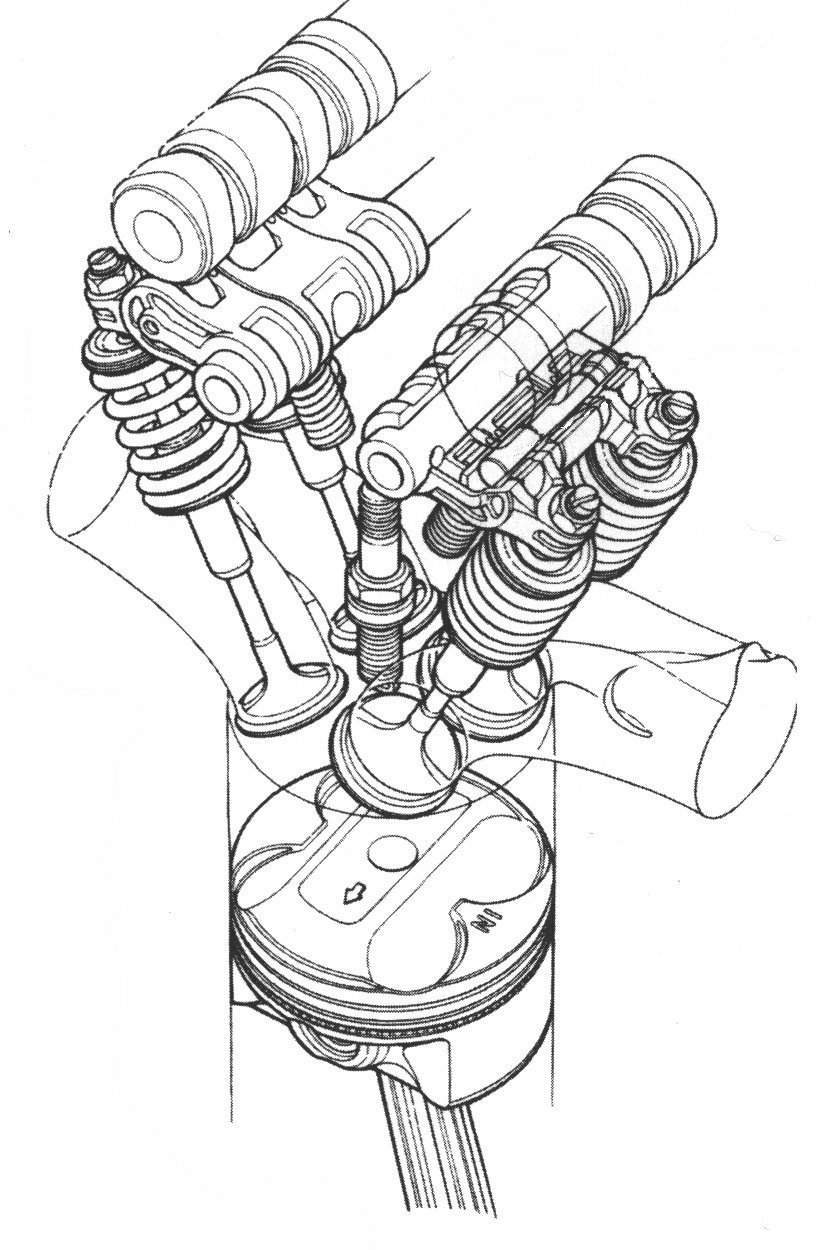
    The V-TEC system is far more complex than the VVT, but it allows you to not only alter the cam timing, but to alter the valve duration and lift at well. It's really like having two engines in one - A 'sedate' one for grocery-getting, and the other a red-blooded high revving screamer.

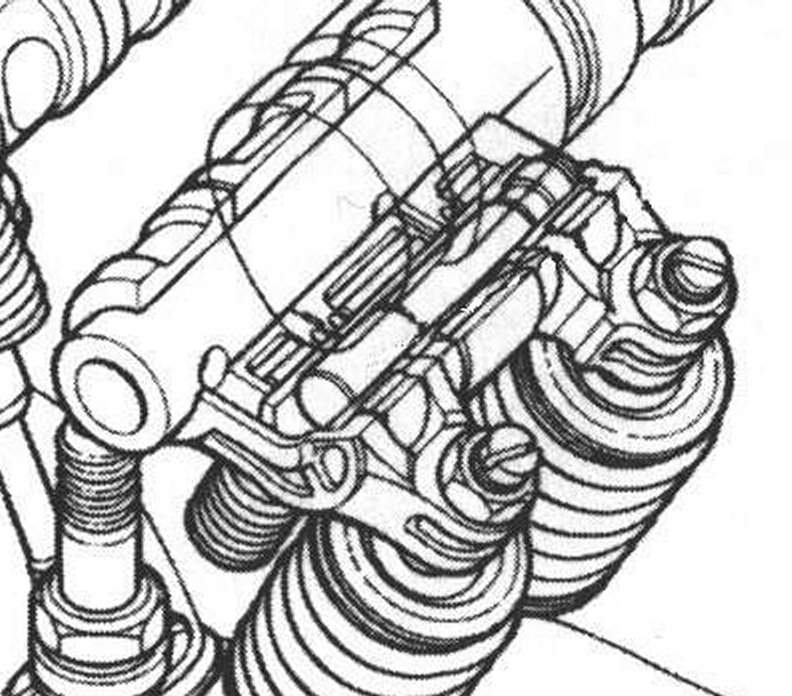
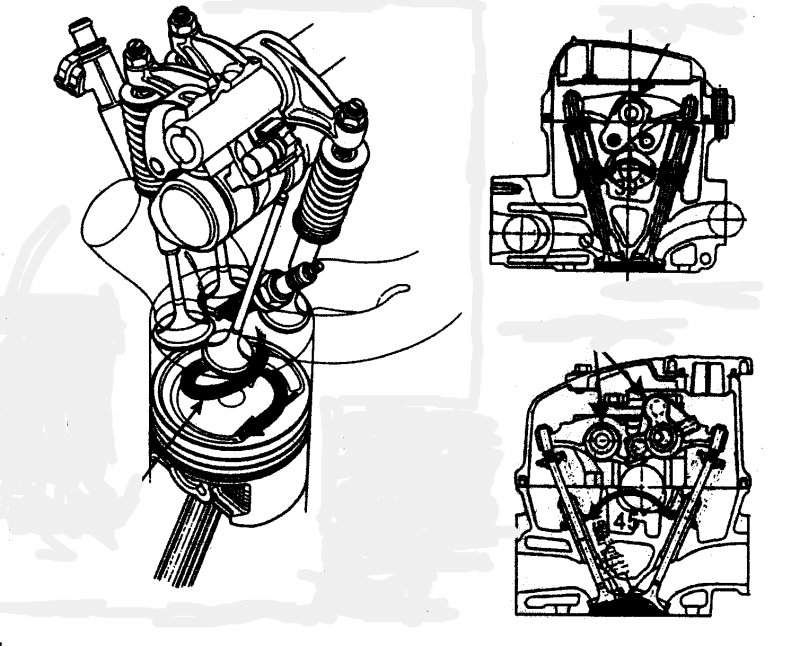
    How it does this, however, is with a multitude of 'fiddly bits'. Here's a picture of the valve gear.

    Or if you can't see enough detail, try this one ->
    (121kb pic <-- and --> 85kb pic)
    Ok, pay attention - This is where it starts to get tricky! What happens when the engine computer decides to make the V-TEC shift to 'grunt' mode is this - Up until that point, the valves are operated by the pair of cam followers that run directly on top of each valve. A hydraulic valve opens in the head somewhere, allowing oil pressure to fill the pivot shaft that the cam followers swing off. The oil is then directed to a tiny set of pins that live in the inner follower. These pins push outwards when the valves are shut, locking the inner cam follower to the two outer followers. The inner follower runs on a cam lobe that sits between the outer two, and is much bigger. This is the lobe that has the larger duration and lift, and so suddenly allows the engine to breath a lot better.
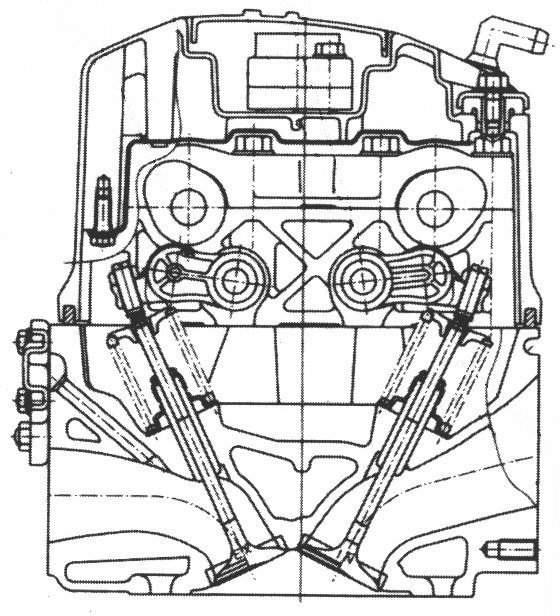
    You can see from the above pictures, and the one below that there's been a huge amount of effort to make it all work. The cam followers all have small rollers, to reduce friction and allow for a larger cam lobe.
    The follower system of valve operation, believe it or not, is quite similar to the latest developments in Formula One engine technology. (Though the F1's don't use V-TEC, have pneumatic valve springs, a smaller included valve angle, and so on ...)
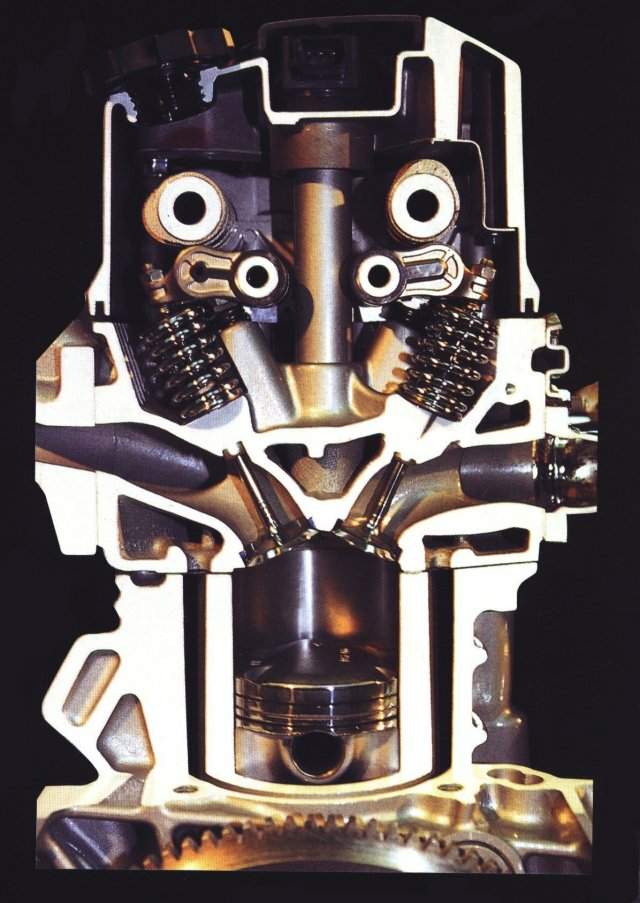
    Here's a picture of a head that's been cross-sectioned. If you look very carefully at the right hand cam, you can just see the larger of the two sets of cam lobes hiding behind the smaller ones.
    Honda have also made a single cam version of the V-TEC, (V-Tir system??) though it only operates on the inlet cam valve timing/duration/lift. As with the twin cam system, it is quite elegant but has many small parts operating under high loads and speeds.

    (84kb pic)
    The point at which the V-TEC system operates is a purely rpm derived point, as was the VVT system, and is done for exactly the same reasons. Because of this, you will not gain anything on a standard engine (either type) by using one of the aftermarket controllers that let you alter the rpm at which the systems operate. All you'll do is create an unpleasant dead spot in the torque curve.

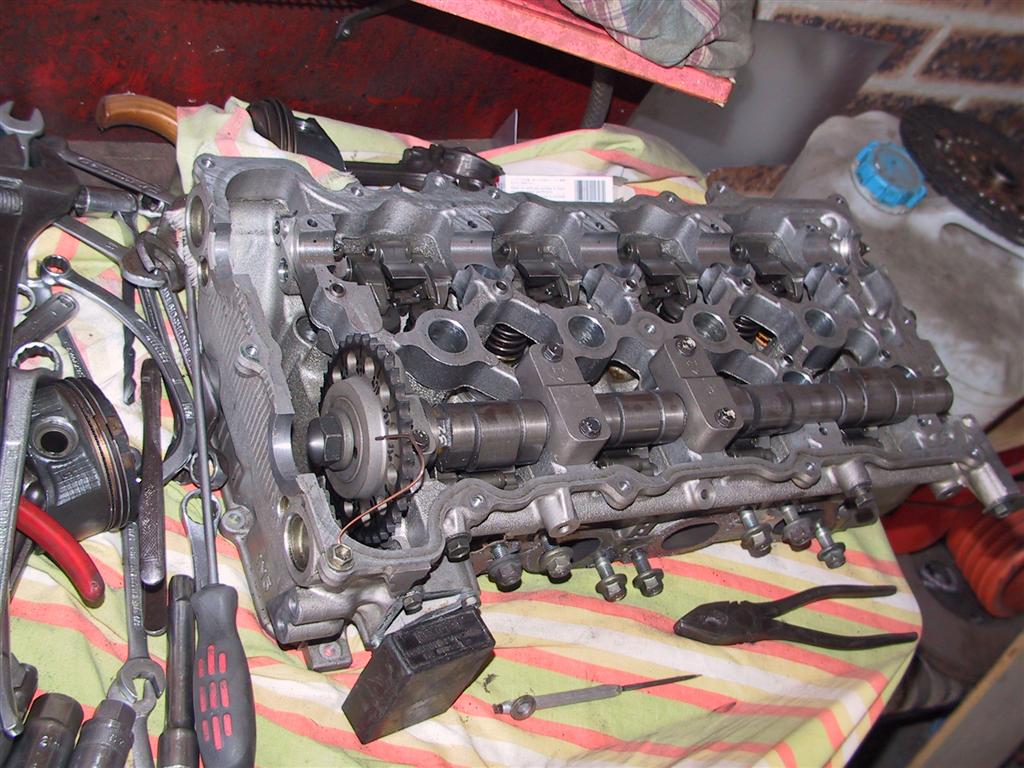
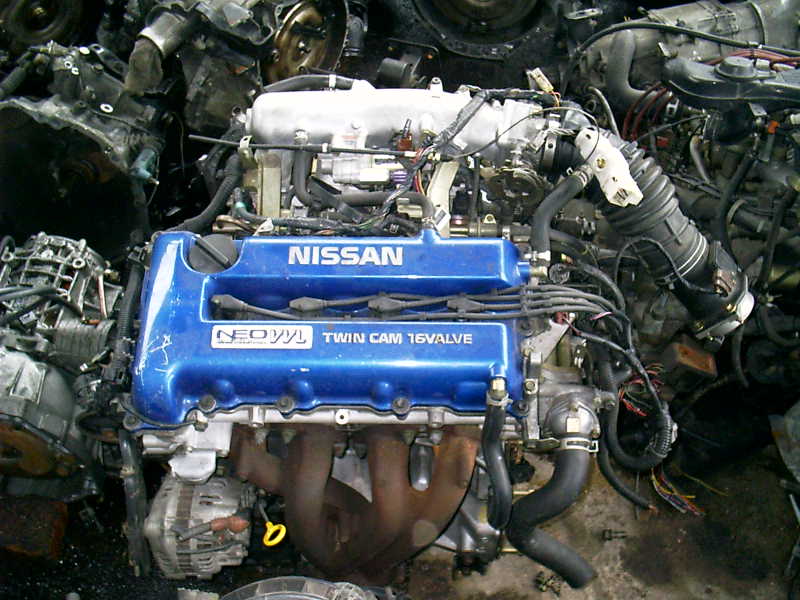
    Below is the Nissan version of V-TEC, the VVL system. It's basically exactly the same as V-TEC in design and operation and so I assume is used under licence. This engine is the SR-16-VVL 'bluetop' and they make about 175hp from the factory. There's a similar N1 version that has a red coloured cam cover and they're reported to make 197hp. There's only suposed to be about 400 bluetops and 80 redtops made, and they were fitted to the faster versions of the Nissan Pulsars in Japan. This engine is my own, and it's going into my Mallock racing car. On the right is how it looked when I picked it up in Malaysia.


    The VVT and V-TEC in operation in the real world

    The Toyota engines seem to run slightly more aggressive cams than the Honda's, and so at lower revs they seem to (anecdotal evidence here ...) be a bit more pleasant to drive and make a little more power. There's also less of a transition when the cam shifting systems operate, but this is obvious due to the Honda system swapping over to a much more 'racy' cam profile. I think that the Honda's may seem to be a little 'flat' at lower revs because of this relatively large contrast, but I'd have to drive one and see a dyno chart to make verify this.
    Pro's - Both systems allow you to have an engine that's quite a lot more powerful and yet still driveable than a 'conventional' engine would otherwise possibly be. The V-TEC is the obvious choice for outright power, and the Honda's certainly seem to rev a heck of a lot more than the Toyota's do. (The S2000 red lines at a stratospheric 9,000rpm - stock!)
    Con's - You are pretty much stuck with limited modifications to the engine, eg, air filters, extractors, etc, to get more power. The reason for this is the very system that give the engine all that extra power - The cams & VVT/V-TEC. You can of course use larger cams to get more power, but this defeats the purpose of having the VVT/V-TEC in the first place. You'll most likely lose power at low revs, and not gain a great deal at high revs. (The VVT will gain proportionally more than the V-TEC, however, as the V-TEC head is optimised - well, compromised - for the 'big' cam & 'small' cam and so using a larger cam may not help much at all)
    So, if you want an engine with power like a racing engine, then you're better off building a straight race engine right from the start. Or maybe a turbo engine ...
    The other concern I have is the longevity of these sorts of engines. I believe that the VVT system would be largely trouble free for the life of the engine provided that you keep the oil clean and change it regularly. Even more so with the V-TEC, as with all it's little bits & pieces in close formation in the head I'd hate to think what would happen if some of those little locking pins didn't engage properly at 6000rpm+. All that being said though, I have it on reliable advice that Honda have never had a warrantee claim for any V-TEC engine in the area of the head and/or valve gear. Quite impressive.

    I think that perhaps the best long term solution to getting large amounts of power from a relatively small engine is still by using a turbo, but if you like to hear the engine scream at high revs then one of these two systems is the way to go.