
 | ||||||||||||||||||||||||||||||||||||||||||||||||||||||||||||||||||||||||||||||||||||||||||
 | ||||||||||||||||||||||||||||||||||||||||||||||||||||||||||||||||||||||||||||||||||||||||||
Galant Fortis has been developed to a product concept that called for "a global sporty sedan that delivers high and well-balanced levels of safety, comfort and environmental performance." Development was aimed to create a new sedan distinguished by: a design that immediately identifies it as a Mitsubishi Motors sedan and gives expression to the feel, the purposefulness and the stable road stance associated with the sedan body style; and by a quality of handling and response and the particular flavor of ride that define the Mitsubishi Motors brand. Principal product features are as follows: Galant Fortis achieves a global standard in living space with a wider and taller body without any undue stretching of overall length. With its wider track the packaging reconciles the requirements of stable handling and response with its excellent maneuverability that stems from a minimum turning radius of 5.0 m.
I. Galant Fortis walkaround
| ||||||||||||||||||||||||||||||||||||||||||||||||||||||||||||||||||||||||||||||||||||||||||
Showing posts with label MiVec. Show all posts
Showing posts with label MiVec. Show all posts
Wednesday, September 26, 2007
New Mitsubishi Sedan - Galant Fortis

Wednesday, September 19, 2007
MIVEC System
In the early ‘90s, Mitsubishi Japan introduced a valve control system to combat Honda’s VTEC design. This system is labelled MIVEC (Mitsubishi Innovative Valve and Lift Electronic Control System).


The first production car to appear with MIVEC technology was the Japanese-market Mitsubishi Mirage Cyborg of late 1992. The Cyborg packs a magnificent little 1.6-litre transverse four boasting DOHC, 16 valves and, of course, variable valve lift and duration. With a high 11:1 compression ratio (making premium unleaded fuel mandatory), the 4G92 MIVEC 1.6 screams out 129kW at 7500 rpm and 167Nm at 7000 rpm. To put things into context, that’s about 10kW more than the famed Toyota 4A-GE 20 valve and Honda VTEC 1.6 engines!

For a full review check out Pre-Owned Performance - Mitsubishi Mirage Cyborg R.
The second MIVEC engine joined the stable in late 1993.

The MIVEC 2-litre V6 (coded 6A12) debuted in a Japanese-market medium size sedan known as the Mitsubishi Eterna Visage R. The small capacity V6 isn’t as highly tuned as the MIVEC 4G92 four but in manual form it easily cranks out 147kW - about the same as a contemporary 2-litre turbo engine. Peak power arrives at 7500 rpm while peak torque (200Nm) is found at 6000 rpm. In comparison to the 4G92 MIVEC, this engine runs a relatively modest 10:1 compression ratio, but it still requires premium unleaded fuel.

The FTO was released in 1994 as the spiritual successor to the Galant FTO of the early ‘70s. In top-line GPX trim, the FTO is powered by the 6A12 2-litre V6 with DOHC, 24 valves and MIVEC. Compression ratio remains at 10:1 and, regardless of transmission, it generates 147kW at 7500 rpm and 200Nm at 6000 rpm. The engine comes tied to a 5-speed manual or INVECSII 4-speed auto with sequential shift.


The MIVEC system in the Grandis is completely unlike the previous high-performance systems that alter inlet and exhaust valve lift and duration. In this incarnation, MIVEC means only variable inlet valve lift and duration. 

Interestingly, the new Outlander (which is due for release in Japan in October 2005) will come powered by a 2.4-litre MIVEC engine that appears very similar to that already sold in Australia. However, with 125kW, the new engine is slightly more powerful than the current 4G69 2.4-litre MIVEC and is expected to achieve a 4-star LEV rating.

The Mitsubishi new-concept minicar i (due for Japanese release in early 2006) will be powered by a turbocharged 660cc three-cylinder MIVEC engine. Class regulations limit engine power to 47kW and torque figures are yet to be finalised. This little buzzer is expected to earn a 3-star LEV rating and return around 15 percent better fuel economy than the current 3G83 turbo three-pot.

Finally, the yet-to-be-released Lancer Evolution 9 will also incorporate MIVEC variable inlet valve timing. Together with few other mechanical changes, the mighty Evo has now cracked 400Nm of torque.

In its simplest form, MIVEC switches between two different intake and exhaust cam lobes depending on engine rpm. At low rpm, the valves receive relatively modest lift and opening duration. At high rpm, the secondary cam lobe is engaged and the valves receive greater lift and duration (which results in increased overlap).
The purpose of the secondary cam lobe is to deliver greater engine breathing and the ability to maintain torque at very high rpm (which means greater power). The MIVEC system achieves its high power without the driveabililty, fuel consumption and emissions trade-offs typical in a conventional engine.

In addition to the base MIVEC principle, Mitsubishi also released a sophisticated MIVEC-MD (Modular Displacement) system in the ‘90s.
The MD system is an early form of cylinder deactivation which involves closing the intake and exhaust valves at light engine load. This means the driver must open the throttle further to maintain power and, as a result, pumping losses are reduced and active cylinder pressures are increased. This results in greater efficiency and fuel economy.
Depending on conditions, the MIVEC-MD system can reduce fuel consumption by 10 – 20 percent.
The 1990s...

The first production car to appear with MIVEC technology was the Japanese-market Mitsubishi Mirage Cyborg of late 1992. The Cyborg packs a magnificent little 1.6-litre transverse four boasting DOHC, 16 valves and, of course, variable valve lift and duration. With a high 11:1 compression ratio (making premium unleaded fuel mandatory), the 4G92 MIVEC 1.6 screams out 129kW at 7500 rpm and 167Nm at 7000 rpm. To put things into context, that’s about 10kW more than the famed Toyota 4A-GE 20 valve and Honda VTEC 1.6 engines!
A MIVEC MD (Modulated Displacement) version was also available. The MD engine makes the same power but with superior fuel economy. Unfortunately, it appears that the MD version was dropped in 1996.
With a close-ratio 5-speed manual or 4-speed auto driving the front wheels, the Mirage Cyborg is one of the most responsive and fastest hatchbacks ever built – it’s guaranteed to get you pumped up! The MIVEC Mirage was continued until 1999.
Also sold in Japan from 1992 was the MIVEC-powered Lancer MR sedan. The Lancer MR uses the same mechanical configuration as the Mirage Cyborg (which means 129kW and 167Nm). A Modulated Displacement version was available to order but was axed in 1996.
The final application of the 4G92 MIVEC engine was in the 1994 Mirage Asti RX coupe. There were no mechanical changes to the engine. The Asti MIVEC range was later expanded to include R and ZR models. The Modulated Displacement engine was not offered. The MIVEC Mirage Asti lasted until 1999.
The second MIVEC engine joined the stable in late 1993.

The MIVEC 2-litre V6 (coded 6A12) debuted in a Japanese-market medium size sedan known as the Mitsubishi Eterna Visage R. The small capacity V6 isn’t as highly tuned as the MIVEC 4G92 four but in manual form it easily cranks out 147kW - about the same as a contemporary 2-litre turbo engine. Peak power arrives at 7500 rpm while peak torque (200Nm) is found at 6000 rpm. In comparison to the 4G92 MIVEC, this engine runs a relatively modest 10:1 compression ratio, but it still requires premium unleaded fuel.
The Eterna Visage R comes with either a 5-speed manual or 4-speed auto. Interestingly, the auto version is detuned to 143kW but generates 2Nm more torque (202Nm) at the same revs. The Visage R was also available in Modulated Displacement guise from late 1994. The line was discontinued in 1995.
The same 6A12 MIVEC V6 was also fitted in the slightly larger 1993 Galant VX-R and 1994 Emeraude Super Touring R. Again, the 5-speed manual version makes 147kW/200Nm while the auto makes 143kW/202Nm. From late 1994, a MD version replaced the normal MIVEC model - this gave these family-oriented sedans a welcome fuel consumption reduction. The Galant and Emeraude Super Touring R were axed in 1995.
The next application for the 6A12 MIVEC V6 was in the snout of the go-fast FTO coupe.

The FTO was released in 1994 as the spiritual successor to the Galant FTO of the early ‘70s. In top-line GPX trim, the FTO is powered by the 6A12 2-litre V6 with DOHC, 24 valves and MIVEC. Compression ratio remains at 10:1 and, regardless of transmission, it generates 147kW at 7500 rpm and 200Nm at 6000 rpm. The engine comes tied to a 5-speed manual or INVECSII 4-speed auto with sequential shift.
The MIVEC-powered FTO was later released in GP Version R spec and the line-up ended in 1999. See Mitsubishi FTO MIVEC V6 GP Automatic for our test of the FTO GP MIVEC.
The most powerful MIVEC engine arrived in early 1995 with the Japanese-market Diamante 30M.
The Diamante 30M (recognised as the KE Verada in Australia) is equipped with a 3-litre V6 packing DOHC MIVEC heads. With the same 10:1 compression ratio as the little 2-litre V6, the big 3-litre MIVEC (coded 6G72) roars out 199kW at 7000 rpm and 301Nm at a relatively low 4500 rpm. Premium unleaded fuel is required.
This monster comes tied to a 5-speed INVECSII sequential auto and drives the front wheels. Unfortunately, the MIVEC 6G72 had a very short lifespan – it lasted only until mid 1997 when the GDi engines took over.
The Current Decade...
In early 2004, the Mitsubishi Grandis people-mover became the first vehicle sold in Australia with MIVEC. But be careful how you interpret the application of the MIVEC name...
With a basic SOHC, 16 valve head and a tame version of MIVEC, the Grandis engine (coded 4G69) makes a conservative 121kW at 6000 rpm and 217Nm at 4000 rpm. The MIVEC system switches to its second stage at 3600 rpm. A 9.5:1 compression ratio means no problem using normal unleaded fuel and, indicative of the engine’s modest performance, it’s sold only with a 4-speed automatic with sequential shift.
See Mitsubishi Grandis for our Grandis test.
In late 2004, the Grandis was joined by the updated Outlander which uses the same 4G69 engine. In Outlander guise, the engine makes 120kW at 5750 rpm and 220Nm at 4000 rpm. Ninety-five percent of peak torque is on tap at 2500 rpm. The AWD Outlander is also available with only an auto transmission.
Late 2004 also saw the debut of the all-new Colt.

The Colt is powered by a 1.5-litre four with a DOHC, 16 valve head and MIVEC. The engine (jointly designed with DaimlerChrysler and coded A9) also incorporates electronic throttle control, tubular extractors and low-friction pistons. It appears that, like the 2.4 litre MIVEC in the Grandis and Outlander, this engine has a MIVEC system that operates only the intake valves. With its 10:1 compression ratio, the engine survives with normal unleaded fuel and generates 72kW and 132Nm (at 6000 and 4250 rpm respectively). See Mitsubishi Colt LS Test for our Colt road test.
At the time of writing, Mitsubishi announced the release of three more MIVEC engines.


Friday, September 14, 2007
CamPro Technology

The Campro engine is the first automotive engine ever developed together with Lotus (car) by the Malaysian automotive corporation, Proton.[1] The name Campro is short for Cam Profile. This engine powers the Proton Gen-2, the Proton Satria Neo, the Proton Waja Campro, the Proton Persona as well as Proton's future models. The Campro engine is aimed to show Proton's ability to make their own engines that produces good power output and meets newer emission standards.
All Campro engines incorporate with drive-by-wire technology (specifically electronic throttle control) for better response,[citation needed] eliminating the need for friction-generating mechanical linkages and cables. There have been some issues with cracking oil sumps but apparently Proton have introduced a new part recently to solve this problem. A recall has not been announced.

Basic DOHC engine
The basic Campro engine coded as S4PH is a basic DOHC 16-valve 1.6 L engine that produces 110 bhp (82 kW) @ 6,500 rpm of horsepower and 148 N-m of torque. This is the engine that powers the Proton Gen-2. The S4PH engine can be fitted with Cam Profile Switching (CPS) and Variable Inlet Manifold (VIM) technology. Besides this 1.6 Litre engine, Proton has produced the 1.3 Litre version of the Campro engine.
Even though the S4PH engine seems to be quite powerful at higher revs, its performance is reportedly sluggish at lower revs and this is proven by driving the Gen-2 uphills where drivers who drive the manual transmission version have to shift a lot between 2nd gear and 3rd gear. This is due to its torque dip in the crucial 2,000 ~ 3,000 rpm operating range, where the torque actually decreases slightly before picking up back to the maximum torque at 4,000 rpm. This torque characteristic can clearly be seen in manufacturer published engine performance curves.
Before the engine is ready to be installed in the Gen-2 cars, Proton installed the engine in the Waja specialized for on-road tests.
Currently the Campro engines installed in the Gen-2 has none of the promised cam profile switching (CPS) and variable inlet manifold technologies. No date nor any information has been known as to when Proton will equip its models with the promised full-spec engine.
Another engine option for the basic DOHC engine is a 1.3L engine coded as S4PE. The S4PH engine produces 94 bhp (70 kW) @ 6,000 rpm and the torque of 120 N-m @ 4,000 rpm, much more powerful than most 1.3L rivals, even with variable valve timing technology, though it too suffers for this omission (like its bigger brother) by displaying a torque dip at typical engine operating speeds.
The bore x stroke dimensions for both engines are as follows:-
- S4PH (1.6L): 76 x 88 mm, resulting the displacement of 1597 cc.
- S4PE (1.3L): 76 x 73.4 mm, resulting the displacement of 1332 cc.
Campro CPS and VIM engine
In addition to the basic DOHC engine, Proton developed its own variable valve timing technology that works similar with other variable valve technologies such as Honda VTEC and Toyota VVTi, named as CPS (Cam Profile Switching) technology. The usage of CPS tehnology will raise the maximum power up to about 127 bhp and will improve the low-end torque to its maximum value which will maintain until about 5,000 rpm.[citation needed] The technology is said to be applied to newer Gen-2s and future models starting from the end of 2005, but currently the CPS technology is still under testing.
The Campro's Variable Intake Manifold technology is currently being developed by Robert Bosch GmbH, and is expected to debut in the second half of 2007
Campro GDI engine
Recently, Proton is developing their own gasoline direct injection version of Campro engines which will be used in the future. Currently, the Campro GDI engine is still under research and development, therefore very little information available for the Campro GDI engine
Hybrid Campro engine
Recently, Proton and Lotus have announced their concept model of a Proton Gen-2 powered by a hybrid powerplant that uses the Campro engine. The concept model will be revealed during the 2007 Geneva Motor Show from 8 ~ 18 March 2007 [1][2].
The hybrid powerplant system, which is known as EVE system (Efficient, Viable, Environmental) will be using the same S4PH engine as the one that powers the present gasoline version of the Gen-2, combined together with a 30 kW, 144V electric motor. The main purpose of the hybrid powerplant system is to provide a hybrid system that can be retrofitted to existing models, retaining the same powerplant and also eliminates the need to develop a completely different platform, like the Honda Civic Hybrid.
The EVE Hybrid System will have 3 key technologies:-
- "Micro-hybrid" start-stop system - An integrated starter-alternator system is installed to switch off the engine automatically when the engine stops, for example at the traffic light. The engine will automatically restart when the gas pedal is depressed.[citation needed]
- Full parallel hybrid technology - Combines the existing S4PH engine with a 30 kW, 144V electric motor, resulting in higher power (141 bhp combined), higher torque (233 N-m combined), lower emission (up to 22% carbon dioxide reduction) and better fuel economy (up to 28%). The system also includes regenerative braking system.[citation needed]
- Continuously Variable Transmission (CVT) - The CVT system provides an infinite number of gear ratios for better efficiency.[citation needed]
The combined power and torque for the powerplant system are as follows:-
- Max power (gasoline engine only): 110 bhp (82 kW) @ 6,000 rpm
- Max torque (gasoline engine only): 148 N-m @ 4,000 rpm
- Max power (combined): 141 bhp (105 kW) @ 5,500 rpm
- Max torque (combined): 233 N-m @ 1,500 rpm (limited to 180 N-m continuous)
VVT Vs V-TEC
A Comparison of the Toyota VVT system Vs the Honda V-TEC
On this page I talk about the two different methods used to increase the power output, and what's good and bad about them.
What the two systems are, and why they are used
So lets have a look at each system, and how they work ...
Toyota Variable Valve Timing system, or VVT & VVT-i
(I can remember seeing a 1960's catalogue from the US that showed a special cam wheel that bolted onto a small block Ford engine's cam, and it had a mechanism that worked like a mechanical advance system in a distributor, so that as the revs picked up it advanced the cam timing. I also believe that Alfa Romeo or Fiat used a similar system back around then, or maybe before)
VVT is simple and fairly effective. It consists of only two main parts; an 'oil control solenoid' and the VVT mechanism itself.

The early VVT system was relatively simple, ie, at a specific rpm (~4400rpm on the 20 valve 4AGE's) the computer signals the OCV to open, this lets oil pressure go through a special gallery in the #1 inlet cam bearing, through the centre of the inlet cam to the VVT pulley. There's a small piston in the VVT pulley, and once it gets enough pressure behind it, it starts to move outwards, causing the outer part of the pulley to turn in relation to the inner part, due to the helical spline that guides the piston's fore & aft movement.

Closer view & cutaway of the VVT controller
So, when the computer signals for the VVT to operate, the OCV opens and thus causes the VVT pulley to advance the inlet cam timing by 30°, reference the crankshaft. (15° on the pulley itself)
The rpm at which this happens is worked out by running the engine on a dynamometer with the inlet cam in both the fully advanced and fully retarded positions. Since the two different cam timing's will make different power throughout the rev range, (advanced inlet give more top end power at the expense of low end power, and vice-versa) there is a point where the power will be identical for both cam settings, and this is where the VVT is programmed to operate. Because the power output is the same with the VVT in either position, you can't feel anything when it happens. You can, however, hear a change in engine note, just before there's a big increase in power!
More detail on the the VVT logic - The VVT comes in three types for the 20 valve. To the best of my knowledge, silvertop 20v's pre May 1993 have the VVT actuate at about 4400rpm. Post May 1993 they seem to work on throttle position and ignore revs.
The blacktops seem to work like this, as described on Club4AG -
1. Starting. When you crank the starter there will be VVT operation until the engine fires up, obviously to allow more air into the engine to allow an easier fire up.
2. Coolant temp. There is absolutely NO VVT operation when the coolant tempt is below 50°C except for that brief moment when you operate the starter. Reason obvious, who want to stress a cold engine.
3. Engine rpm. VVT will operate in any rpm between the range of 1500 and 7200 when the inlet manifold pressure is right. The min and max range can be a little out because I was reading from the car tacho. Trust me they are very close.
4. Engine load/inlet manifold pressure. This seems to be the single most important parameter controling the system. The VVT will NOT operate if the inlet manifold has more than about 5 inches of vacuum (can't get the exact reading because everything happen so fast. It's very close.). This is very close to zero vacuum which is atmospheric and that is about the maximum load the map sensor will read to tell the engine in an NA car. As you can figure out the throttle will usually be in the more than 3/4 position for this to happen.
5. VVT will work without the speed sensor.
Now, back to the above schematic of the VVT. It shows the second evolution of the VVT system - called VVT-i - where instead of the simple 'on' or 'off' positions of the earlier VVT system, this version can make the inlet cam retard/advance to any angle between the maximum limits, and to do this the camshaft has a position sensor on the back of the head. This means that the engine is even more flexible in it's power output than before. The latest version, VVTL-i is described on this page. It's completely different to the original VVT system, and is more like the V-TEC in operation.
There are two engines that commonly use the VVTL-i system, the 1ZZ-FE/2ZZ-GE series and the latest (in 1999 & onwards) 3SGE, as used in the sporty Altezza. The early generation 'redtop' four 3SGE's have a single inlet VVT-i and the later 'blacktop' generation four 3SGE's have dual VVT-i controllers, one on the inlet and the other on the exhaust cam, and makes 200hp from 2 litres.
So, using VVT technology, it's pretty easy to get around 100hp per litre.
Toyota has now gone to the third evolution of the VVT, and it not only alters the cam timing, but it also alters the valve lift as well. The 'old' VVT system simply can't do this, so Toyota has gone to a system much like the ....
HONDA V-TEC
The V-TEC system is far more complex than the VVT, but it allows you to not only alter the cam timing, but to alter the valve duration and lift at well. It's really like having two engines in one - A 'sedate' one for grocery-getting, and the other a red-blooded high revving screamer.
How it does this, however, is with a multitude of 'fiddly bits'. Here's a picture of the valve gear.
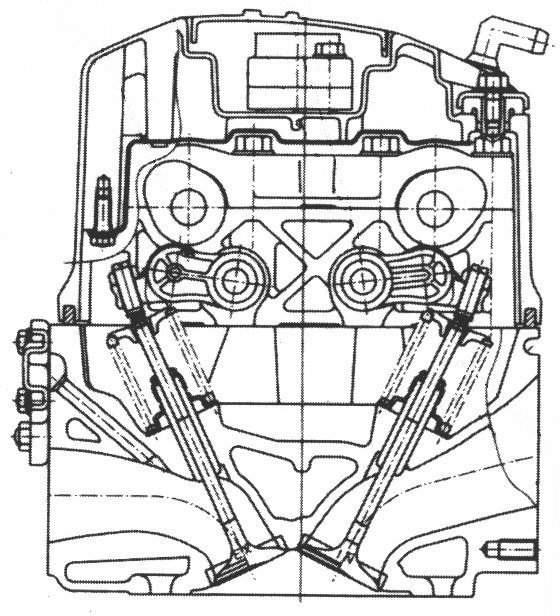
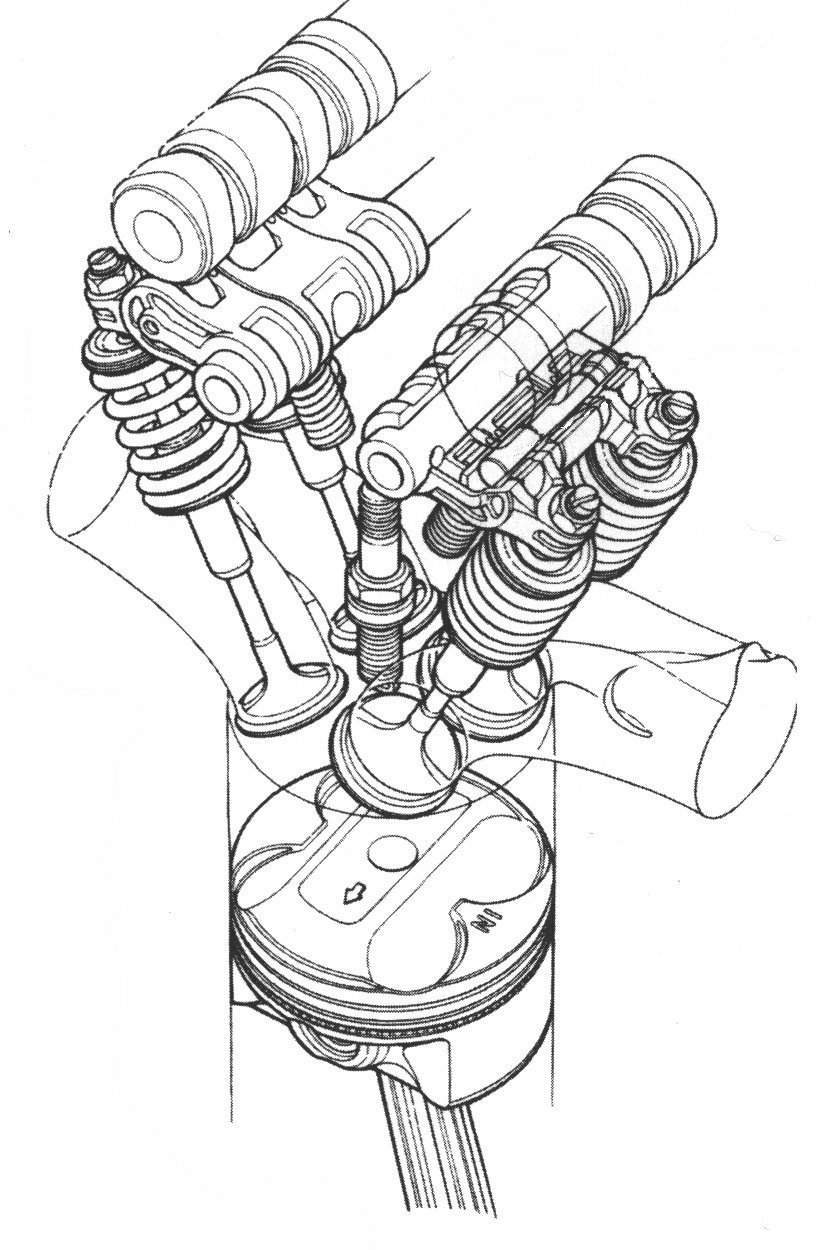 | (121kb pic <-- and --> 85kb pic) | 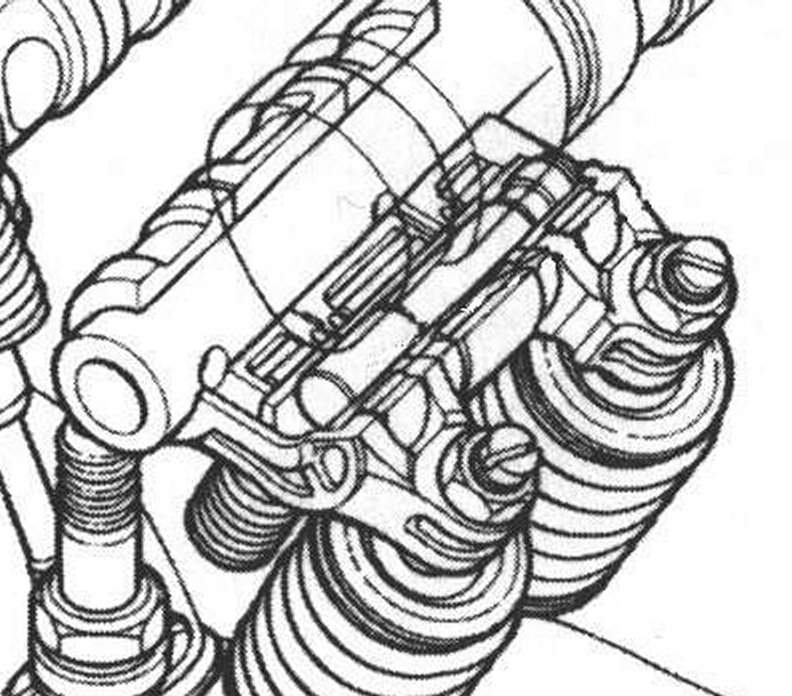 |
You can see from the above pictures, and the one below that there's been a huge amount of effort to make it all work. The cam followers all have small rollers, to reduce friction and allow for a larger cam lobe.
Here's a picture of a head that's been cross-sectioned. If you look very carefully at the right hand cam, you can just see the larger of the two sets of cam lobes hiding behind the smaller ones.
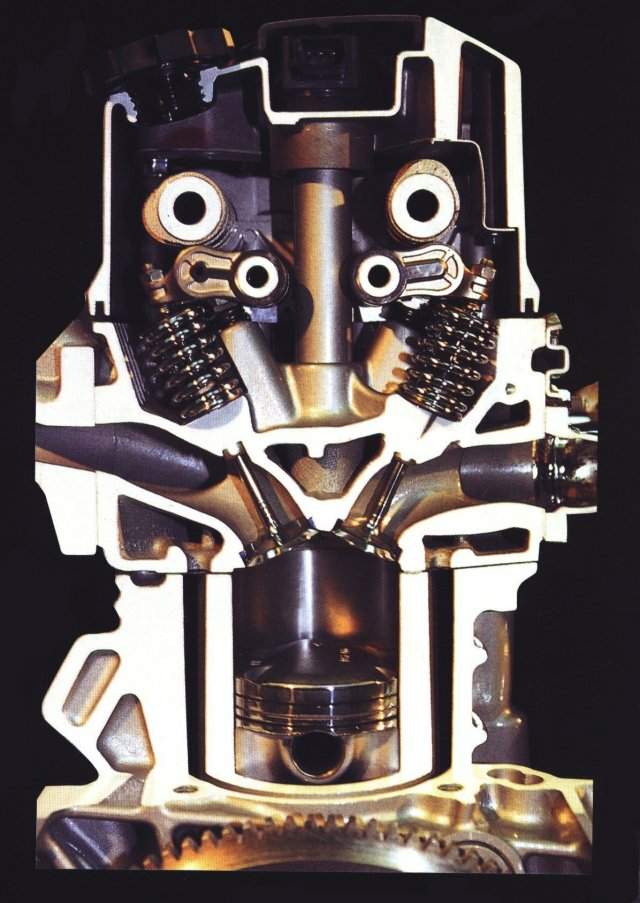
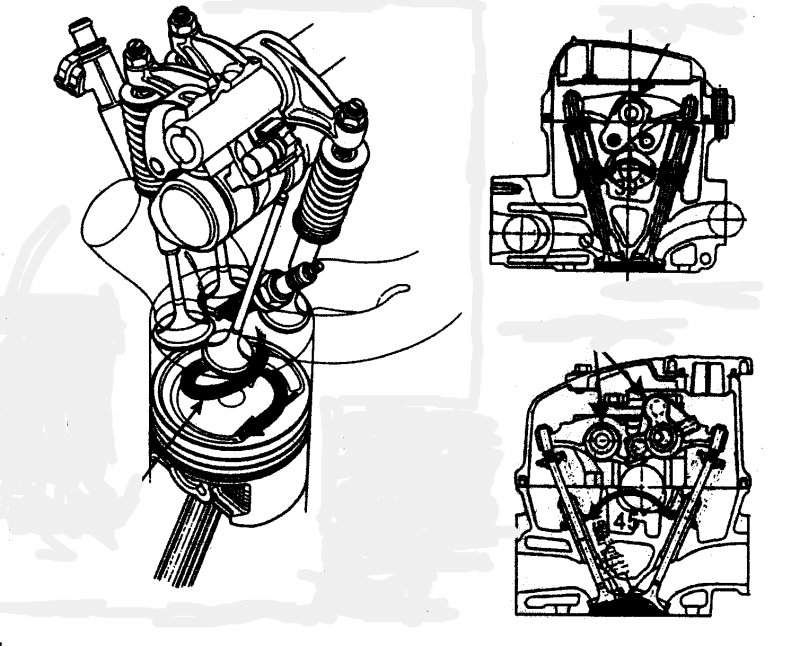
(84kb pic)
Below is the Nissan version of V-TEC, the VVL system. It's basically exactly the same as V-TEC in design and operation and so I assume is used under licence. This engine is the SR-16-VVL 'bluetop' and they make about 175hp from the factory. There's a similar N1 version that has a red coloured cam cover and they're reported to make 197hp. There's only suposed to be about 400 bluetops and 80 redtops made, and they were fitted to the faster versions of the Nissan Pulsars in Japan. This engine is my own, and it's going into my Mallock racing car. On the right is how it looked when I picked it up in Malaysia.
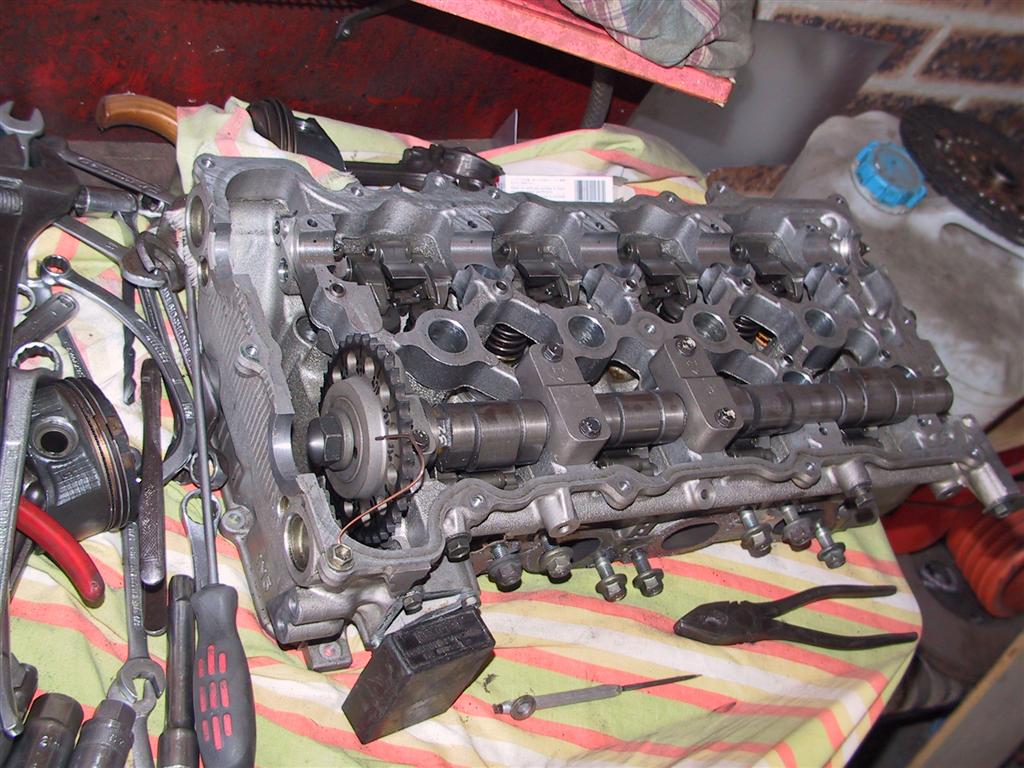
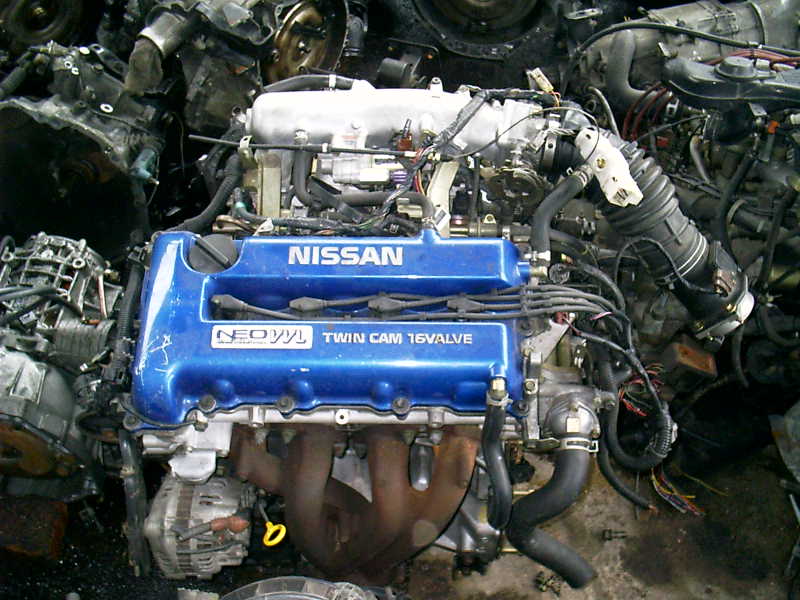
The VVT and V-TEC in operation in the real world
Pro's - Both systems allow you to have an engine that's quite a lot more powerful and yet still driveable than a 'conventional' engine would otherwise possibly be. The V-TEC is the obvious choice for outright power, and the Honda's certainly seem to rev a heck of a lot more than the Toyota's do. (The S2000 red lines at a stratospheric 9,000rpm - stock!)
Con's - You are pretty much stuck with limited modifications to the engine, eg, air filters, extractors, etc, to get more power. The reason for this is the very system that give the engine all that extra power - The cams & VVT/V-TEC. You can of course use larger cams to get more power, but this defeats the purpose of having the VVT/V-TEC in the first place. You'll most likely lose power at low revs, and not gain a great deal at high revs. (The VVT will gain proportionally more than the V-TEC, however, as the V-TEC head is optimised - well, compromised - for the 'big' cam & 'small' cam and so using a larger cam may not help much at all)
So, if you want an engine with power like a racing engine, then you're better off building a straight race engine right from the start. Or maybe a turbo engine ...
The other concern I have is the longevity of these sorts of engines. I believe that the VVT system would be largely trouble free for the life of the engine provided that you keep the oil clean and change it regularly. Even more so with the V-TEC, as with all it's little bits & pieces in close formation in the head I'd hate to think what would happen if some of those little locking pins didn't engage properly at 6000rpm+. All that being said though, I have it on reliable advice that Honda have never had a warrantee claim for any V-TEC engine in the area of the head and/or valve gear. Quite impressive.
I think that perhaps the best long term solution to getting large amounts of power from a relatively small engine is still by using a turbo, but if you like to hear the engine scream at high revs then one of these two systems is the way to go.
Subscribe to:
Posts (Atom)